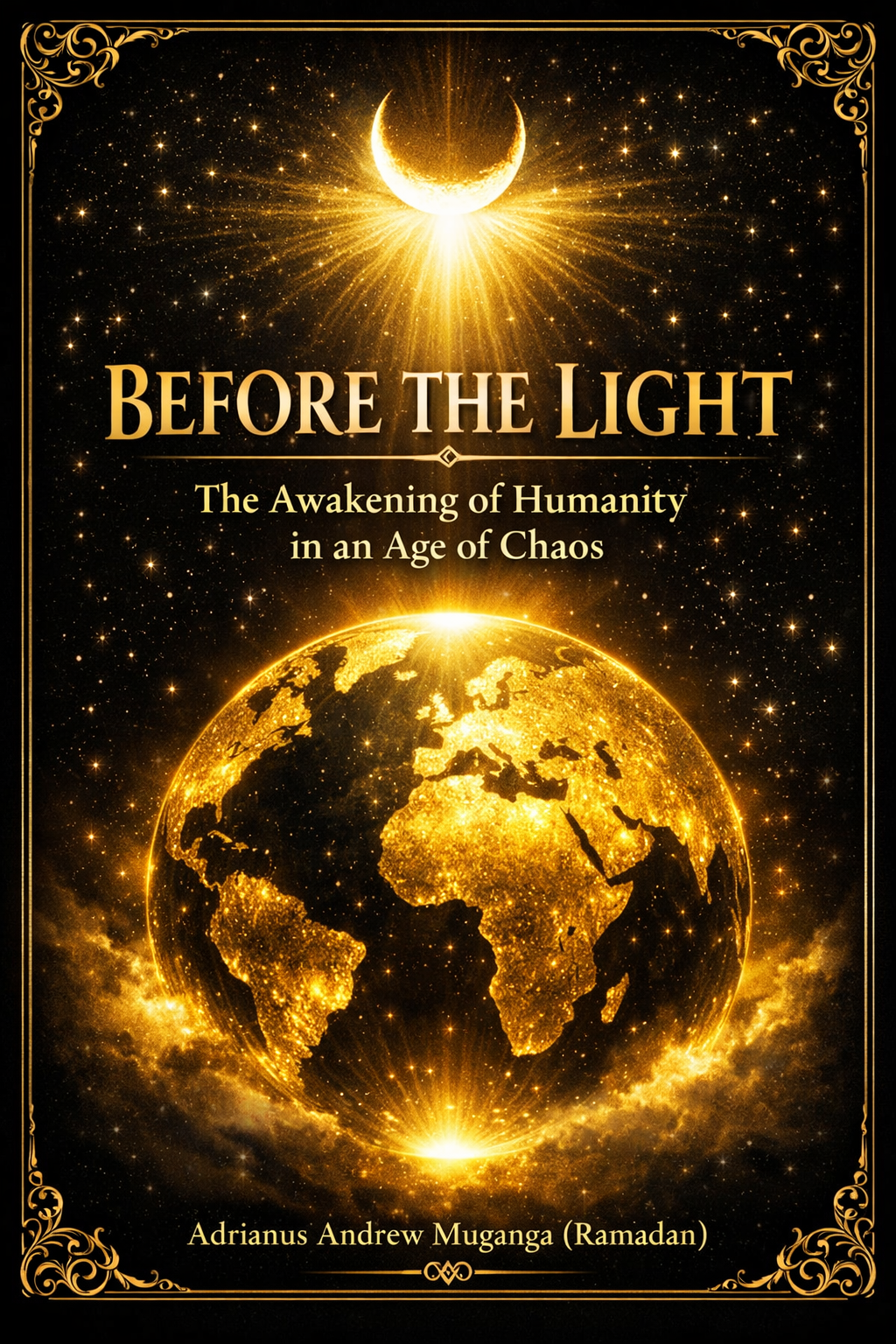
Before the Light: The Awakening of Humanity in an Age of Chaos is a reflective and analytical work that examines the moral, structural, and historical dimensions of the contemporary global condition. Rather than approaching modern instability as a series of isolated crises, the book situates the present moment within a longer human pattern in which systems outgrow conscience, authority detaches from accountability, and suffering becomes normalized through procedure rather than intent.
The book begins with recognition. In its opening sections, it gives language to a widespread but often unspoken experience: the sense that the world no longer operates as it claims to. Across societies described as stable, people feel increasing pressure, declining trust, and moral confusion. Institutions continue to function, policies continue to be enacted, and progress continues to be announced, yet lived reality contradicts official explanations. This disconnect, the book argues, is not the result of individual failure or temporary disruption. It is a signal that foundational structures have lost alignment with human dignity.
Part I focuses on this collective unease. It examines how order can persist while becoming harmful, how peace can exist without justice, and how growth can occur without dignity. Stability is shown not as a neutral achievement, but as a condition that can mask deep injustice when it prioritizes system preservation over human life. The book carefully distinguishes between order that protects life and order that demands endurance at the expense of conscience. It emphasizes that societies rarely collapse when people stop obeying rules, but when obedience is stretched beyond what human dignity can sustain.
Part II shifts the reader from recognition to understanding by placing the present moment within a broader historical and cross-civilizational context. Drawing on patterns observed across Hindu, Abrahamic, African, and philosophical traditions, the book introduces the idea of a late-stage moral age often described as a “dark age” not as prophecy, but as a recurring condition. This age is characterized by moral inversion, concentration of power, erosion of accountability, and the normalization of harm. The concept of Kali Yuga is used not as a belief system, but as a descriptive framework that helps explain why similar symptoms appear across different civilizations and eras.
This section reframes what many experience as collapse as exposure. The book argues that darkness does not emerge suddenly, but matures gradually behind complexity, language, and distance. Partial corruption can hide; complete corruption cannot. When systems become fully detached from conscience, they lose their ability to disguise harm as necessity or progress. At that point, illusion breaks. What feels apocalyptic is not the end of life, but the end of narratives that once justified suffering. The book stresses that this exposure is not punishment, but consequence, and that it creates the conditions necessary for clarity and responsibility.
Part III introduces the central metaphor of the work: “the Beast without a face.” This refers not to a person, nation, or ideology, but to systems of power that operate without visible accountability. The book examines how harm is organized through legality, bureaucracy, and institutional distance. When responsibility is diffused across procedures and policies, no individual appears culpable, yet suffering is produced consistently. The Beast is shown to thrive not through chaos or brutality, but through normalization—through rules that cannot be questioned, structures that prioritize efficiency, and narratives that redefine domination as order.
Historical examples are used to illustrate how empires, regardless of culture or ideology, follow similar patterns when power becomes self-justifying. Figures such as Nero and Alexander are examined not as anomalies, but as expressions of a recurring logic in which authority mistakes itself for necessity. The book emphasizes that the greatest danger of such systems is not cruelty, but emptiness the absence of conscience where moral responsibility should exist.
Part IV explores the consequences of systems losing their moral center. It examines how aid becomes conditional, how justice becomes procedural, and how governance increasingly serves power rather than people. This section focuses on the architecture of inequality, showing how suffering can be embedded into policy without malice, yet with devastating effects. Neutral language is shown to be one of the most effective tools of harm, as it allows injustice to persist without appearing violent or intentional.
Part V widens the lens to a global scale, describing a shared awakening occurring across regions and generations. The book does not portray this awakening as unified ideology or coordinated rebellion, but as a convergence of exhaustion. Different societies experience unrest, refusal, and questioning in different forms, yet the underlying pattern is the same: patience has been exhausted, and legitimacy is being questioned. Youth are highlighted not as instigators of chaos, but as indicators of a future that no longer accepts inherited loss as inevitable.
Part VI addresses the concept of unity, carefully stripping it of both romanticism and fear. Unity is not presented as uniformity, revenge, or domination. It is framed as leverage, balance, and collective maturity. The book argues that fragmentation is one of the primary tools of control in late-stage systems, and that unity, when grounded in dignity and restraint, disrupts exploitation without requiring violence. Historical examples are used to show that societies do not fail because people unite, but because they unite too late or without ethical grounding.
Part VII brings the work to its ethical foundation. God is presented not as a religious boundary, but as the highest accountability beyond all systems. The book argues that order cannot be restored through force, ideology, or replacement hierarchies. Restoration requires re-centering conscience above profit, life above efficiency, and responsibility above authority. Awakening is defined not as disruption, but as clarity the ability to see without illusion and act without hatred.
The book concludes by emphasizing that Before the Light is not about the end of the world. It is about the moment before renewal, when illusion dissolves and responsibility becomes unavoidable. It offers no blueprint for revolution and no promise of comfort. Its contribution lies in naming what has been normalized, connecting what has been fragmented, and returning fundamental moral questions to public consciousness. What follows the light, the book insists, depends entirely on what humanity chooses to carry forward.
#Ethics
#Conscience
#Power
#Human Dignity
#Moral Responsibility




_ebookfrontcover.jpeg)