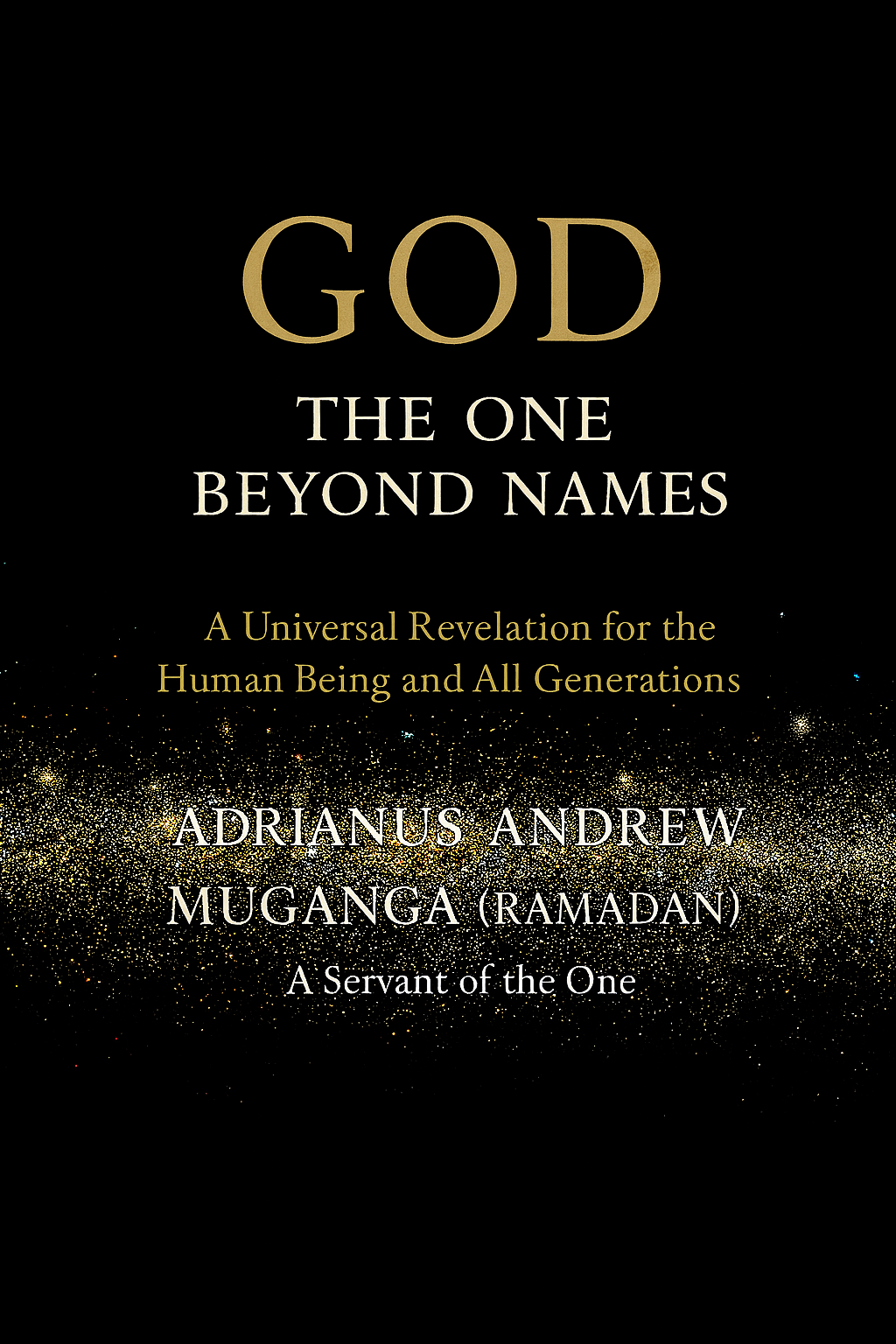
GOD: THE ONE BEYOND NAMES is the culminating work in an eleven-book journey exploring the deepest layers of existence, human perception, cosmology, and the universal quest for the Divine. Across its pages, the book brings together the four great pillars of human knowledge tradition, mystery, philosophy, and science to reveal a unified understanding of the Source that transcends all boundaries of culture, religion, and language.
At its core, the book addresses a fundamental problem: humanity seeks to understand God using tools not designed for perceiving the Infinite. The senses capture only a fragment of the physical world; the mind filters and reshapes information through memory, emotion, and culture; traditions interpret revelation through their own historical needs; and science focuses exclusively on measurable phenomena. These limitations create a veil a perceptual boundary that hides the true nature of the Divine. The book’s purpose is to reveal how this veil formed, how it can be lifted, and what lies beyond it.
Part I: The Veil and the Human Condition
The book begins by examining why human beings struggle to perceive God clearly. Human senses detect less than one percent of reality, while the mind distorts and reshapes what it receives. People live inside “cognitive containers” cultural frameworks, inherited beliefs, and emotional filters that define what feels true or possible. Using analogies like the fish in the ocean and the cave of shadows, the book shows how familiarity creates illusion and how most people mistake the container of belief for truth itself.
This part concludes by introducing a new vision: a perspective that moves beyond assumption and integrates all four domains of knowledge to approach the Divine without distortion.
Part II: The Four Paths to the Divine
Humanity has relied on four major systems to understand reality:
Tradition, which carries ancient teachings and revelations
Mystery, which addresses the unseen realms and spiritual phenomena
Philosophy, which attempts to reason about existence
Science, which measures the physical universe
Each system contributes essential insight, yet each is incomplete alone. Tradition preserves wisdom but often becomes rigid. Mystery reveals hidden dimensions but lacks structure. Philosophy sharpens understanding but cannot reach beyond the limits of thought. Science maps the physical world but cannot enter the metaphysical. The book argues that the deepest truths can emerge only when these four paths converge rather than compete.
Part III: The Great Revelation—All Paths Unite
This section demonstrates that the world’s spiritual traditions, mystical frameworks, philosophical systems, and scientific discoveries share a common foundation. When separated, they appear contradictory. But when placed side by side, they reveal a unified pattern. This “collapse of boundaries” is described as water leaving the urn: when the container breaks, the contents merge into a larger, coherent whole.
The book highlights the universal themes found across traditions—cosmic order, moral unity, divine oneness, and the return of creation to its Source. It shows that revelation in every civilization, whether prophetic, mystical, or philosophical, reflects the same Infinite Reality translated through different cultural languages.
Part IV: The Multi-Layered Cosmos
Across religions, mythologies, and scientific models, the universe is consistently described as layered. The concept of “seven levels” appears in the Abrahamic heavens, Hindu lokas, chakras, mystical cosmologies, and even natural sciences like light, sound, and Earth’s internal structure. The book explains that these are not separate systems but different descriptions of a single cosmic architecture.
This section also describes the purpose of a layered universe: to guide creation back toward increasing refinement, awareness, and proximity to the Source. The human being mirrors this structure internally, possessing layers of consciousness that correspond to the layers of the cosmos.
Part V: Creation and the Return to the One
Every tradition describes a universal process: creation emerges from the Infinite, unfolds through stages of manifestation, and ultimately dissolves back into the Source. Whether expressed through the Hindu cycles of dissolution, Sufi fana’, Kabbalistic emanation, Christian and Islamic eschatology, or scientific models of cosmic collapse, the theme remains the same: all that exists returns to the One.
The book argues that these models are not contradictory but complementary. They describe different facets of a single metaphysical process.
Part VI: God—The One Beyond Names
This is the heart of the book. Here, the author presents a universal definition of God stripped of cultural, historical, and doctrinal limitations. God is not matter, energy, form, or concept. God cannot be contained by images, names, or boundaries. The Divine is the Infinite Source of all existence, beyond time, place, and structure.
Names of God across traditions are presented as windows, not walls ways of approaching the Infinite, not definitions of It. God is unseen not out of distance but out of mercy, allowing free will, preventing idolatry, and encouraging internal discovery.
Part VII: Humanity and the Divine Connection
This section explores the human being as a mirror of the Divine. The soul, consciousness, intuition, moral awareness, and the longing for meaning are presented as traces of the Infinite within each person. Humanity’s potential rises above angels when aligned with the Divine and falls below animals when governed by ego.
Awakening requires recognizing the divine signature within the self, the universe, and all beings.
Part VIII: The Return of Remembrance
The book describes the modern age as a period of spiritual blindness, characterized by confusion, conflict, technological acceleration, and the collapse of traditional structures. Yet it is also the beginning of global awakening. As old paradigms crumble, humanity becomes capable of perceiving the unseen, understanding unity beyond religion, and recognizing the Divine without boundaries.
Final Message
The book ends with a call for humility, clarity, compassion, and inner stillness. It urges the reader to move beyond the inherited divisions of belief and rediscover the One Reality behind all names. The final blessing affirms that the journey to God is ultimately the journey back to the self where the Source has always been present.
#Spirituality
#Metaphysics
#Cosmology
#Divine Reality
#Awakening



_ebookfrontcover.jpeg)