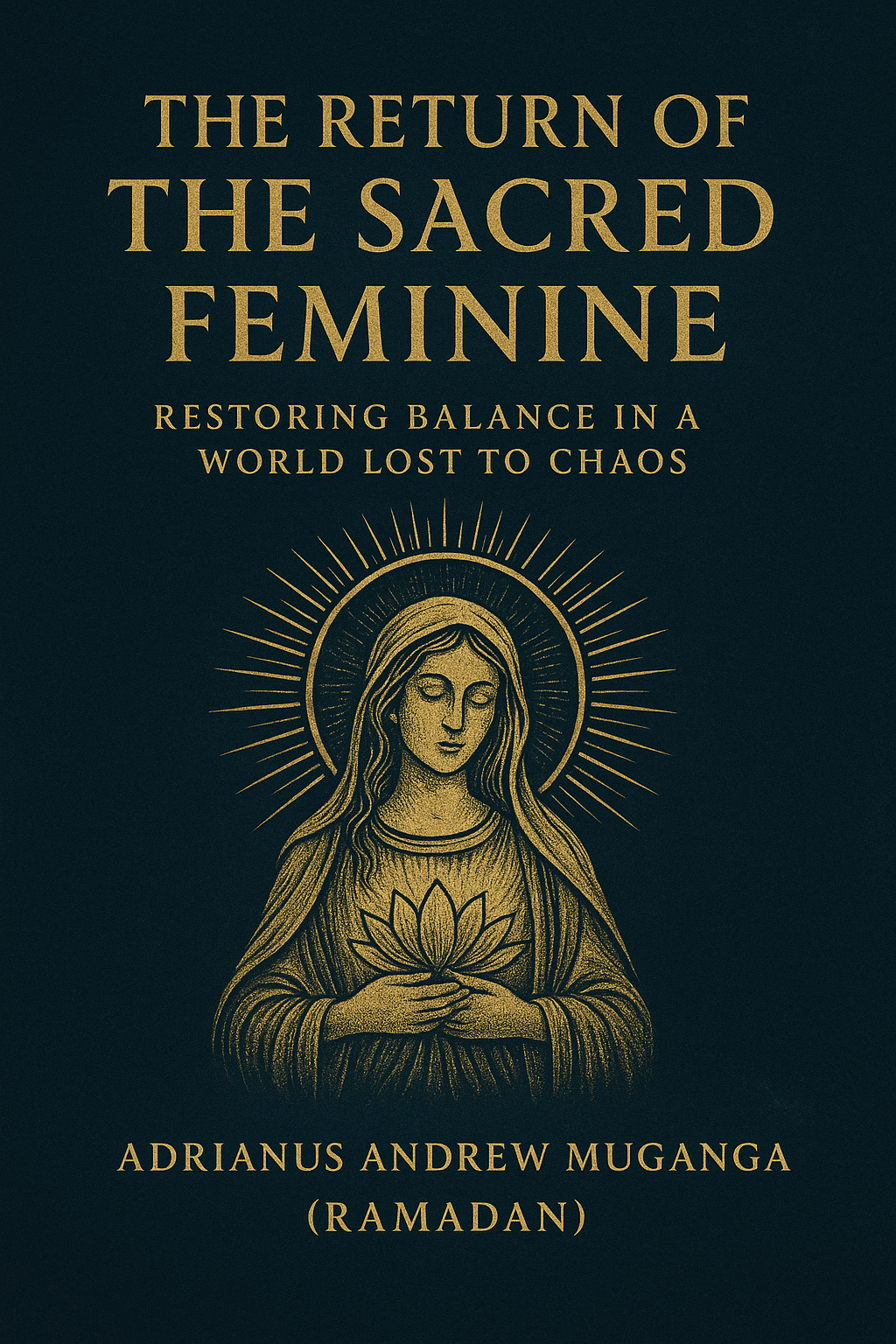
The Return of the Sacred Feminine: Restoring Balance in a World Lost to Chaos is the twelfth and final volume of a sweeping spiritual and philosophical revelation series by Adrianus Andrew Muganga (Ramadan). Written from Tanzania in 2025—a symbolic land of peace and feminine leadership—this book delivers a profound diagnosis of the global crisis of the 21st century and a blueprint for humanity’s spiritual, cultural, ecological, and psychological restoration. At its core, the book argues that modern civilization is collapsing because it has forgotten the Sacred Feminine, the cosmic energy of intuition, compassion, creation, balance, and relational harmony that once anchored human existence.
The book begins by establishing a universal cosmological principle: everything in the universe arises from two forces—masculine consciousness and feminine energy. These forces are not gendered but cosmic, appearing across spiritual traditions as Shiva and Shakti, Yin and Yang, Spirit and Waters, Sun and Moon, Osiris and Isis, Purusha and Prakriti. Science, biology, psychology, and metaphysics echo this duality as particle and field, seed and soil, intellect and intuition, left brain and right brain. Creation requires both. But when one is suppressed, imbalance becomes destiny—and the world begins to fall apart.
Part I examines how the feminine principle became forgotten across millennia. Early human societies were cooperative, matrifocal, and balanced, recognizing women as carriers of life, agriculture, healing, and spiritual wisdom. However, as scarcity, warfare, property ownership, and hierarchy intensified, societies shifted toward patriarchal structures. Masculine traits like conquest, dominance, and expansion were elevated for survival. Later, religious institutions codified this dominance, replacing earth-based feminine spirituality with sky-based masculine authority. Feminine symbols were erased or demonized, and women’s roles in healing, leadership, and knowledge were systematically eliminated. The consequence was civilizational imbalance: societies became brilliant yet spiritually starved, strong yet emotionally broken, advanced yet disconnected from nature.
Part II explores the ancient blueprints that preserved the understanding of balance even as societies changed. From Indian cosmology (Shiva + Shakti) to Taoist harmony (Yin + Yang), from the Sun–Moon duality found worldwide to African earth-based cosmologies, humanity has always known that life itself is relational and cyclical. These systems taught that masculine structure without feminine flow becomes rigid and destructive, while feminine fluidity without masculine grounding becomes unfocused. Harmony emerges only from union. By revisiting these ancient models, the book reveals timeless frameworks for balance that modern civilization desperately needs to remember.
Part III highlights historical evidence of feminine leadership and the essential but forgotten role women played in shaping global civilizations. From African queens and warriors to prophetesses, healers, and intellectuals across cultures, history reveals a pattern: whenever feminine leadership was strong, societies were more stable, collaborative, and humane. The book argues that women were not feared because they were weak, but because they carried a form of power that patriarchal systems could not control—spiritual authority, emotional intelligence, intuitive insight, and the ability to unify diverse groups.
Part IV turns toward the modern world, analyzing the 21st-century crisis as the predictable outcome of suppressing the feminine principle. The rise of hypermasculine systems—technology without compassion, economies based on extraction, politics rooted in domination, and societies driven by competition—has produced emotional emptiness, mental collapse, ecological destruction, widening inequality, and the breakdown of relationships and communities. The book explores phenomena like burnout, loneliness, AI replacing feminine-coded roles, and ecological collapse as direct reflections of humanity’s inner imbalance. The Earth itself is reacting to this spiritual disconnection.
Part V centers on Tanzania as a symbolic vessel for the restoration of balance. Known for peace, unity, and cultural harmony, Tanzania becomes the geographic and spiritual ground from which the author writes. The presidency of Samia Suluhu Hassan—Tanzania’s first female leader—is presented not as a political event but as a spiritual sign of rising feminine leadership in an age of global turmoil. This section explores how lands and leaders become chosen vessels in divine timing and how Tanzania carries a quiet but powerful role in the planetary rebalancing that is beginning.
Part VI outlines what the feminine principle truly is: not softness or gender, but the energy of nurturing, healing, wisdom, connection, cyclical understanding, and deep intuitive knowing. It explains how individuals can restore feminine balance within themselves, how men can heal wounded masculinity without rejecting their strength, and how societies can rebuild structures rooted in both justice and compassion. Feminine restoration is presented as a planetary necessity, not a cultural trend.
Part VII offers practical transformation strategies—personal, communal, and national. From emotional healing practices to community rebuilding, policy shifts, and cultural reforms, this section shows how feminine energy can reshape education, economics, politics, and spirituality. It includes guidance for leaders, families, and communities seeking to awaken a new social fabric based on empathy, balance, and shared purpose.
Part VIII concludes the entire twelve-book series with the “Final Seal,” detailing the purpose of the series and the author’s calling as a messenger. It presents God’s timeless message for the modern era: humanity has reached a critical point where it must choose between collapse and restoration. The return of the feminine principle is God's invitation to heal the world, restore creation’s original design, and birth a new era of balance.
The book ends with direct messages to Tanzania, Africa, global leaders, religions, and humanity at large—urging unity, humility, remembrance, and the return to divine balance. The author emphasizes that the feminine is not returning as a cultural movement but as a cosmic correction. The world cannot survive on masculine energy alone. Survival, healing, and awakening now depend on restoring the feminine principle in every dimension of life.
Ultimately, The Return of the Sacred Feminine is both revelation and roadmap—a call to awaken, a warning to a wounded civilization, and a vision of a new era built on harmony, compassion, and cosmic balance. It argues that the future of humanity depends not on more power, speed, or technology, but on remembering the forgotten half of creation and restoring the union that once sustained the world.
#Sacred Feminine
#Divine Feminine
#Spiritual Awakening
#Cosmic Balance
#Metaphysical Spirituality






_ebookfrontcover.jpeg)