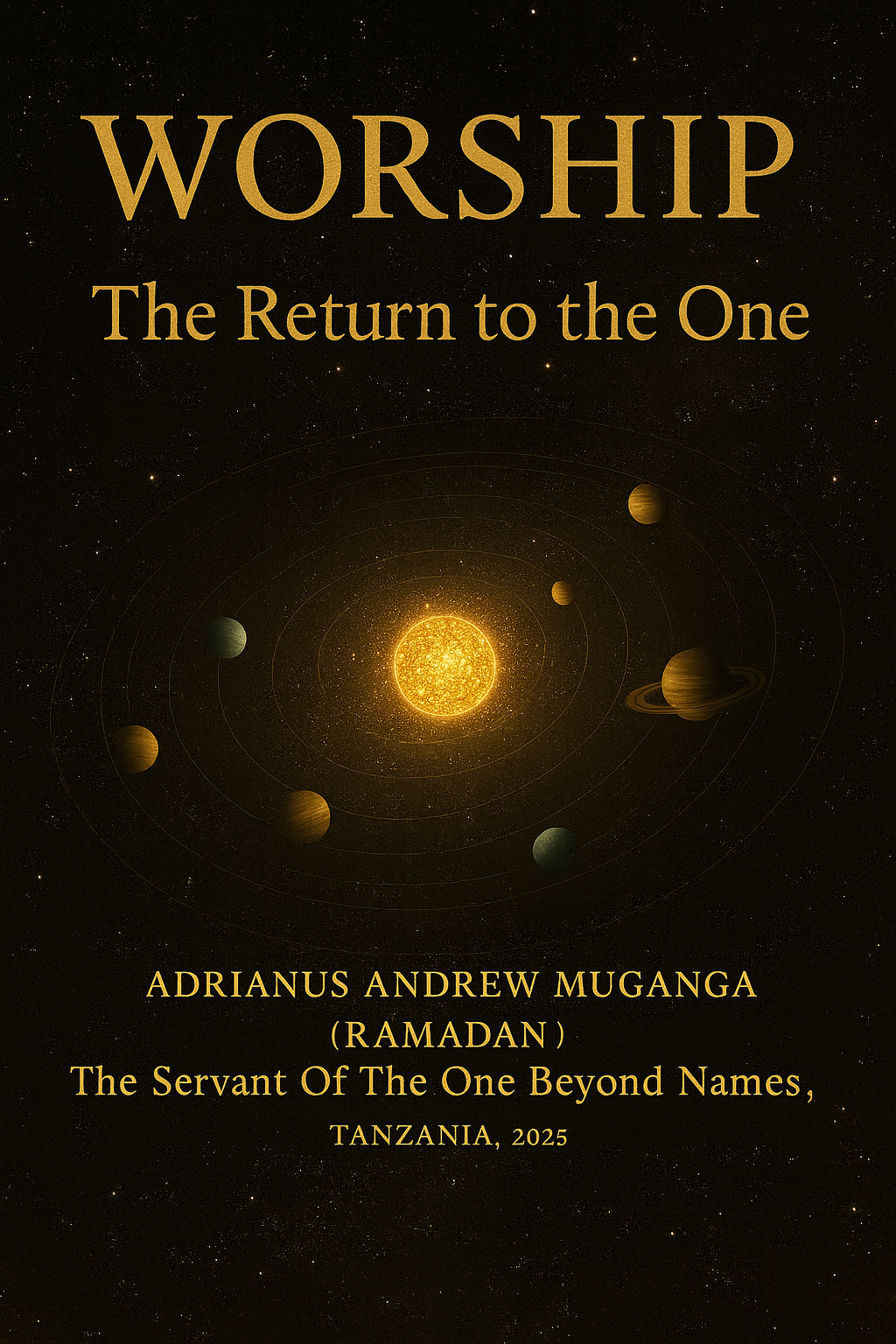
WORSHIP: The Return to the One is the concluding volume of a twelve-book journey examining humanity’s recurring forgetting of what is ultimate and the consequences of that misalignment. Rather than presenting a new doctrine, belief system, or institutional position, the book functions as a final clarification. It gathers what has been revealed throughout the earlier works and brings it to resolution through one central insight: worship, in its original and undistorted meaning, is alignment of life with the One Source of all existence.
The book opens by addressing the condition of the modern world, described as an age of noise. Despite unprecedented access to information, humanity remains divided, restless, and fearful. The text argues that this condition is not the result of ignorance or lack of progress, but of misplacement. What was meant to serve life—systems, power, identity, and structures—has gradually replaced what is ultimate. When orientation is lost, confusion multiplies. Information increases while wisdom declines. Power separates from conscience, and fear becomes a governing force rather than a warning signal.
From this diagnosis, the book moves to its central observation: division is not the root problem of humanity, but a symptom. Differences in belief, culture, and identity exist naturally, but they become destructive only when something deeper has already shifted. When worship is displaced, truth becomes secondary to loyalty, identity hardens into defense, and fear enters the human heart. Humanity begins to fight over names, symbols, and claims of ownership rather than living in alignment with what is shared and enduring.
The second major movement of the book focuses on dissolving false objects of worship. This process is not presented as destruction or rebellion, but as restoration of proper scale. The text dismantles three foundational illusions: ownership, false power, and mediation. It argues that no land can contain or own God, no people can possess truth as property, and no lineage can inherit access to the divine. These claims, while often rooted in fear and the search for security, distort what they attempt to protect. What is universal cannot be owned without being reduced.
The book then examines the collapse of power when it detaches from humility. Authority without conscience, wealth without mercy, and fear used as control are shown to be unstable and ultimately self-defeating. Power that no longer answers to something beyond itself loses legitimacy and must increasingly rely on force or fear to survive. This collapse is not portrayed as punishment, but as a natural consequence of misalignment.
Closely related is the end of intermediaries. The text emphasizes that nothing stands between humanity and God. Guidance, teaching, and shared wisdom may point, but they cannot replace direct responsibility and alignment. When intermediaries become substitutes rather than supports, individuals defer conscience and transfer responsibility outward. The dissolution of intermediaries restores immediacy. Alignment becomes personal, direct, and unavoidable.
After this dissolving phase, the book turns toward remembering. What remains after false centers fall away is not something new, but something always present. The text affirms the One Source as the origin of all existence, beyond name, form, and image. This Source does not belong to time, culture, or language. Creation arises from it, but it is not altered by creation. Recognition of the One Source is not framed as belief, but as clarity that emerges when claims of separation are removed.
From this recognition flows the understanding of shared breath. Before identity, belief, or difference, all human life enters the world through the same condition. Equality is not argued as a moral ideal but revealed as an existential fact. Life is received, not earned. No breath carries greater permission to exist than another. This understanding dissolves hierarchy without erasing difference. Function does not determine worth, and no role authorizes domination.
Life, the book explains, is a sacred trust rather than a possession. When life is treated as property, fear governs and control follows. When life is understood as entrusted, humility returns and responsibility becomes natural. Harm is no longer justified through systems or identities because alignment is measured by conduct rather than affiliation.
With these foundations restored, worship itself is redefined. Worship is not ritual performance, verbal declaration, or institutional participation. It is alignment expressed through how life is lived. When recognition of the One Source, shared breath, and sacred trust is present, worship becomes continuous rather than occasional. Work, relationships, silence, and decision-making all become expressions of worship when they are aligned with truth.
The book emphasizes living truthfully as the visible expression of worship. Truthfulness here is not ideological correctness but coherence between inner awareness and outward action. Justification and avoidance are identified as the roots of untruth. When responsibility is owned rather than deferred, fear loses its leverage. Speech becomes measured, silence becomes meaningful, and action becomes consistent whether observed or unseen.
Pure love and humility are presented as natural outcomes of alignment, not moral achievements. Love becomes undistorted when it no longer seeks control, reward, or identity. Humility is described as accuracy rather than self-denial—recognition of one’s proper scale in relation to the One Source. Together, these stabilize worship as lived reality rather than belief.
The final movement of the book addresses return as a law of existence. Everything that arises within form—individuals, civilizations, systems, and identities—moves toward return. Nothing within time remains forever. Suffering increases when impermanence is resisted and temporary things are treated as permanent. Attachment produces fear, and fear drives control, accumulation, and conflict.
Return, however, is not presented as loss or annihilation. It is resolution and reintegration. What ends is form, not origin. The book distinguishes between kingdoms built within time and the Kingdom that does not fall. This enduring Kingdom is not political, religious, or institutional. It does not require recognition or defense. It is entered through alignment, not belief, and exists as a present condition rather than a future reward.
As the twelfth and final volume, WORSHIP: The Return to the One brings the written journey to completion. It releases names, vessels, debates, and claims. It offers no call to follow, convert, or agree. Instead, it leaves the reader with responsibility: to live aligned with what is recognized.
The book closes in silence rather than instruction. Nothing more is argued or added. What remains is simple and demanding: worship restored as life lived in truth, humility, and care, oriented toward the One Source from which all things come and to which all things return.
#Worship
#Spiritual Alignment
#Unity
#Truth
#Return



_ebookfrontcover.jpeg)