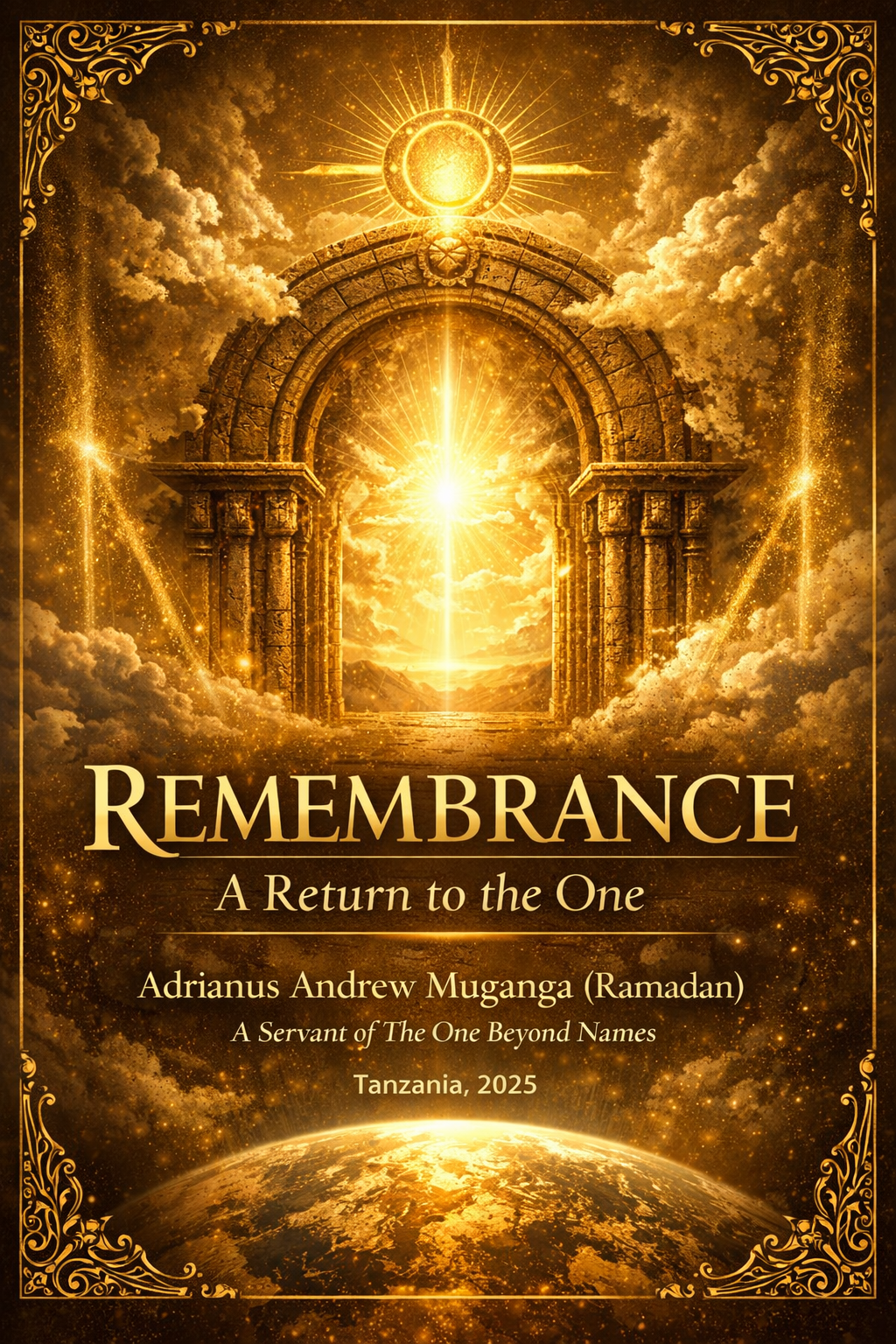
REMEMBRANCE: A Return to the One
Subtitle: A Return To The One
Author: Adrianus Muganga
REMEMBRANCE: A Return to the One examines the roots of human division through a reflective analysis of faith, responsibility, and conscience. Rather than presenting doctrine or ideology, the book explores how belief gradually became separated from ethical accountability and absorbed into identity, power, and institutional control. This separation, it argues, has allowed faith to be defended as possession rather than lived as responsibility. Tracing recurring patterns across history and traditions, the work shows how worship was reduced to ritual, truth to membership, and morality to obedience. The resulting consequences division, selective compassion, and normalized harm are presented not as failures of belief itself, but as outcomes of misalignment between faith and conduct. Written without argument or persuasion, REMEMBRANCE speaks beneath institutions rather than against them. It proposes no new religion or system, calling instead for the restoration of individual responsibility, humility, and shared humanity before the One beyond names.
Keywords for this book
You can only order 1 ebook at a time
Book summary
REMEMBRANCE: A Return to the One is a reflective and analytical work that examines the roots of human division through the lens of faith, responsibility, and conscience. Written in response to a century marked by unprecedented technological power and persistent moral fragmentation, the book does not propose a new belief system, ideology, or institutional reform. Instead, it seeks to uncover a deeper and older question: how humanity’s relationship with faith became separated from responsibility, and how that separation continues to shape conflict, inequality, and selective compassion across the world. The central premise of the book is that division is not primarily caused by differences in belief, culture, or tradition, but by a misalignment between what people claim to believe and how they live, judge, and exercise power. Across history, faith originally functioned as moral orientation an alignment of conscience, humility, accountability, and responsibility toward others and toward the Source beyond human ownership. Over time, however, this orientation became formalized into systems of identity, authority, and control. Belief was no longer lived as responsibility but defended as possession. The book traces this transformation carefully, showing how religion and faith were gradually absorbed into institutions, politics, and collective identities. In this process, worship was reduced to ritual compliance, truth to group membership, and morality to obedience. God, rather than remaining beyond ownership and representation, became associated with particular names, flags, tribes, or powers. Once belief became something to own and defend, it also became something to weaponize. Rather than singling out any single religion, culture, or historical moment, REMEMBRANCE emphasizes patterns that repeat across traditions and eras. Wherever faith detaches from responsibility, similar consequences emerge: division between “us” and “them,” selective compassion limited to insiders, justification of harm in the name of righteousness, and the erosion of personal accountability. Violence, exploitation, and exclusion are shown not as accidents of belief, but as predictable outcomes of belief severed from conscience. A key argument of the book is that institutions themselves are not inherently corrupt, nor is belief inherently dangerous. The problem arises when responsibility is outsourced when individuals transfer moral accountability to systems, leaders, doctrines, or identities. When people stop asking what is right and instead ask what is permitted, required, or defended by their group, conscience becomes dormant. At that point, faith no longer restrains power; it serves it. The book deliberately avoids argument, debate, or polemics. It does not attempt to persuade readers through confrontation or rhetorical force. Instead, its method is unveiling. Through historical observation, moral reasoning, and ethical reflection, it invites readers to recognize familiar patterns in their own contexts. The text repeatedly returns responsibility to the individual, emphasizing that no institution, scripture, or authority can substitute for moral accountability. Another major theme is the distinction between belief as identity and belief as alignment. When belief becomes identity, it divides by definition: one belongs, another does not. When belief functions as alignment, it manifests through conduct justice, mercy, humility, restraint, and accountability regardless of labels. The book argues that humanity’s deepest moral truths were never intended to separate people by name or affiliation, but to regulate behavior and protect dignity. REMEMBRANCE also addresses the modern global context, where technological and political power have outpaced moral development. In a world capable of immense creation and destruction, the cost of misaligned belief has grown exponentially. The book suggests that the crises of the present age religious conflict, ideological extremism, systemic injustice, environmental neglect, and normalized violence are symptoms of a deeper moral amnesia. Humanity has forgotten that power without responsibility is not progress, and belief without accountability is not faith. Importantly, the book does not call for the abandonment of religion or spirituality. It does not advocate secularism, relativism, or skepticism as solutions. Nor does it elevate reason above faith or replace spirituality with philosophy. Instead, it calls for remembrance: a return to the original function of faith as moral responsibility before the One beyond names, beyond ownership, and beyond manipulation. The work emphasizes that remembrance is not intellectual nostalgia or romantic idealism. It is practical and demanding. It requires honesty, self-examination, and the willingness to relinquish moral comfort. Remembrance restores the burden of responsibility to the individual, where it cannot be hidden behind doctrine, majority, or authority. In this sense, the book offers no comfort to illusion and no shelter to denial. Throughout the text, the author maintains a deliberately restrained voice. There are no enemies named, no groups condemned, and no instructions issued. This restraint reflects one of the book’s core convictions: that clarity does not require aggression, and responsibility does not require command. The absence of prescriptions is intentional; the book insists that responsibility cannot be imposed without becoming another form of control. The final sections of REMEMBRANCE focus on what becomes possible when responsibility is restored. Without proposing a system or program, the book suggests that coexistence, peace, and justice are not achieved through uniform belief but through shared accountability. Unity, as presented here, does not mean sameness or agreement, but mutual recognition of dignity and consequence. It is unity without uniformity, grounded not in ideology but in conscience. Ultimately, REMEMBRANCE: A Return to the One is not a book about changing the world directly. It is a book about restoring the conditions under which change becomes meaningful and ethical. It challenges readers to reconsider what they defend, whom they exclude, and what responsibilities they have transferred to others. It offers no final answers, only clarity and the understanding that once clarity is restored, neutrality is no longer possible. This book is written for readers willing to engage honestly with difficult questions, to examine faith beyond inheritance, and to accept responsibility for the moral weight of belief. It does not promise resolution, but it insists on accountability. In a time of noise, certainty, and division, REMEMBRANCE chooses silence where slogans might appear, and responsibility where authority is often claimed.
Book details















_ebookfrontcover.png)