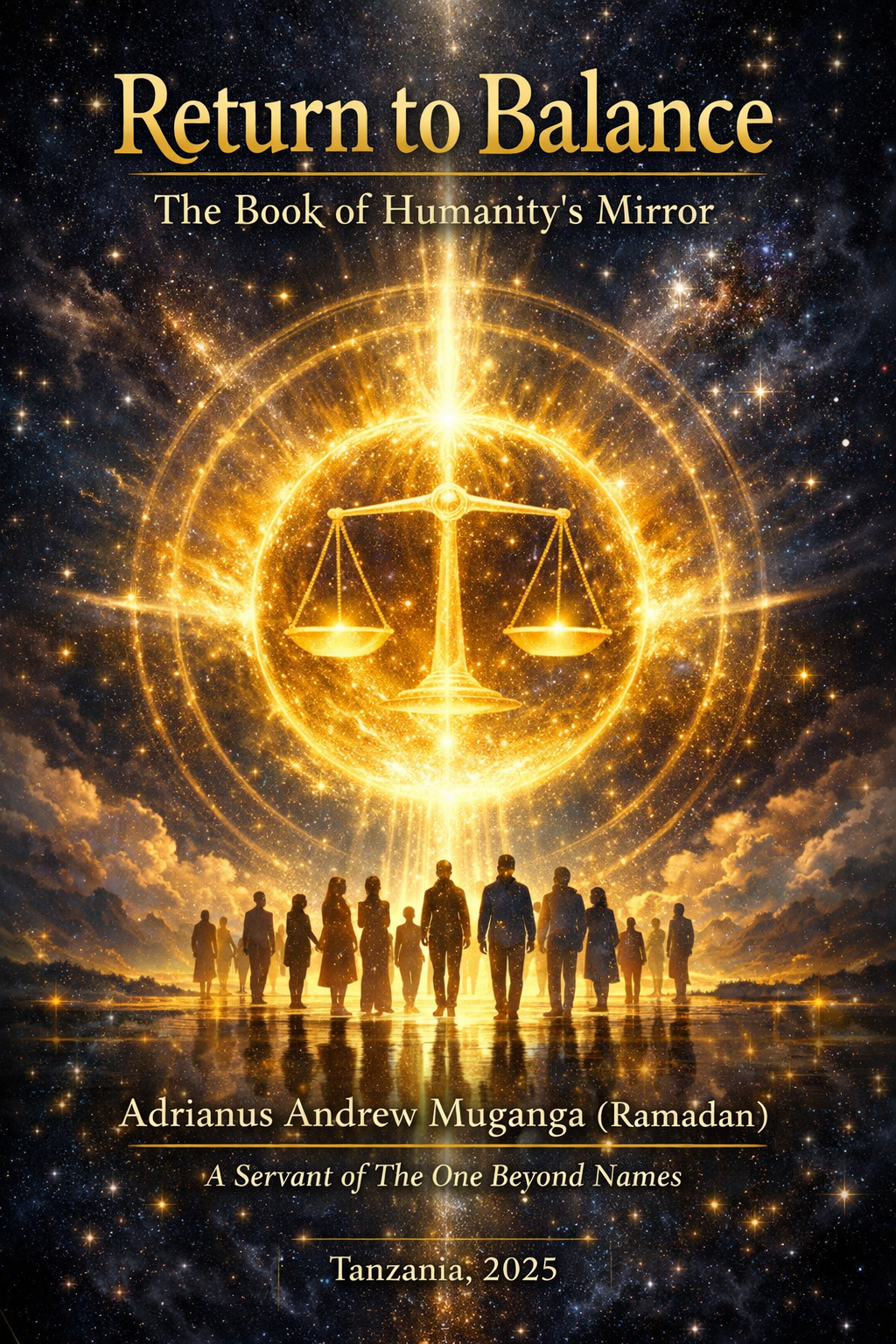
Return to Balance: The Book of Humanity’s Mirror is a reflective and analytical work that examines the moral, spiritual, and structural condition of humanity from ancient history to the present age. Rather than functioning as a religious text, political manifesto, or philosophical theory, the book presents itself as a mirror inviting readers to observe recurring patterns of human behavior and to recognize the universal law that governs life: balance sustained through service, humility, and responsibility.
At its core, the book argues that all existence natural, social, political, and spiritual operates according to an eternal law of balance. When human actions align with this law, societies flourish; when they violate it, collapse follows. This principle is not framed as punishment or divine wrath, but as consequence. Just as nature corrects imbalance through droughts, floods, and decay, human systems correct misalignment through moral decline, social unrest, and institutional failure.
The opening sections establish this foundation by exploring the concept of alignment with the Source the ultimate origin of life beyond names, traditions, or institutions. Alignment is defined not by belief, ritual, or identity, but by action. Service to life, especially care for the weak and marginalized, is presented as the only reliable and universal measure of moral and spiritual integrity. Love without action, faith without responsibility, and power without service are exposed as empty performances that accelerate imbalance.
The book then turns to the lives and teachings of prophets and sages across cultures and civilizations. From Adam to Muhammad, and alongside figures such as Buddha, Confucius, Taoist sages, African elders, Indian philosophers, and indigenous leaders of the Americas, a consistent message emerges: true authority exists to serve life, not to dominate it. Despite differences in language and context, these traditions converge on the same principles humility, responsibility, compassion, and care for the vulnerable. Their lives are presented not as objects of worship or historical reverence alone, but as practical templates for alignment.
Building on this foundation, Return to Balance examines how power has historically separated itself from service. Ancient thrones, palaces, and fortresses are analyzed not merely as architectural achievements, but as moral symbols. They reveal priorities: protection of the elite over protection of the people, luxury over care, isolation over accountability. The pharaohs of Egypt are explored as early examples of authority elevated above responsibility, where grandeur and fortification masked neglect of the weak. This pattern is shown to repeat across empires and civilizations.
One of the most vivid case studies is Alexander the Great. Celebrated in history for his ambition, intelligence, and conquest, Alexander is presented here as a cautionary example of ego unchecked by service. His rapid expansion and early death illustrate a central theme of the book: achievement without alignment is hollow. Power, talent, and vision, when divorced from responsibility to life, produce instability rather than legacy. His empire fractured almost immediately after his death, reinforcing the book’s claim that imbalance inevitably corrects itself.
The analysis then moves into the modern world, drawing parallels between ancient structures of exclusion and contemporary systems of power. Gated communities, fortified political compounds, economic inequality, and elite isolation are identified as modern equivalents of thrones and forts. Political systems that claim representation while neglecting the vulnerable, and faith institutions that accumulate wealth while ignoring suffering, are presented as evidence that the same ancient patterns persist under new forms.
A significant portion of the book focuses on faith structures and their deviation from original intent. Founders and prophets emphasized service, humility, and care, yet over time, many institutions developed hierarchies that favor the wealthy and powerful. Ritual, visibility, and material offerings often replaced responsibility to the poor and marginalized. The book highlights how this distortion has contributed to widespread disillusionment, particularly among youth, who increasingly disengage from systems they perceive as hypocritical or unjust.
Throughout the work, the weak and marginalized are consistently presented as the moral test of any society. Orphans, the poor, the sick, the displaced, and the voiceless are not peripheral concerns; they are the mirror that reveals whether alignment exists. When systems require the powerless to prove their worth before receiving care, misalignment is already present. The book emphasizes that charity alone is insufficient—what is required is structured, sustained responsibility.
Rather than offering solutions in the form of policies or doctrines, Return to Balance calls for awareness, reflection, and conscious choice. It invites readers to observe patterns honestly, without defensiveness or blame, and to recognize their own role within these systems. Restoration is presented as possible, but only through a return to foundational principles: service above ambition, humility above ego, responsibility above privilege, and life above all structures.
The final chapters offer a call to remembrance and realignment. Humanity is urged to step back from forgetfulness and to reclaim the timeless truths that have guided life since its beginning. Balance is not portrayed as an abstract ideal, but as a practical orientation that must shape leadership, faith, economics, and personal conduct. Every individual, community, and institution is shown to have a role in either sustaining or disrupting harmony.
In essence, Return to Balance: The Book of Humanity’s Mirror is a contribution to human conscience and historical memory. It does not seek to persuade through fear or promise reward through belief. Instead, it illuminates, reflects, and invites. Its central message is clear and uncompromising: alignment with the Source is demonstrated through service to life, and the future of humanity depends on whether this truth is remembered and lived.
#Humanity And Balance
#Moral And Spiritual Alignment
#Service And Ethical Leadership
#Power And Responsibility
#Global Wisdom Traditions



_ebookfrontcover.jpeg)