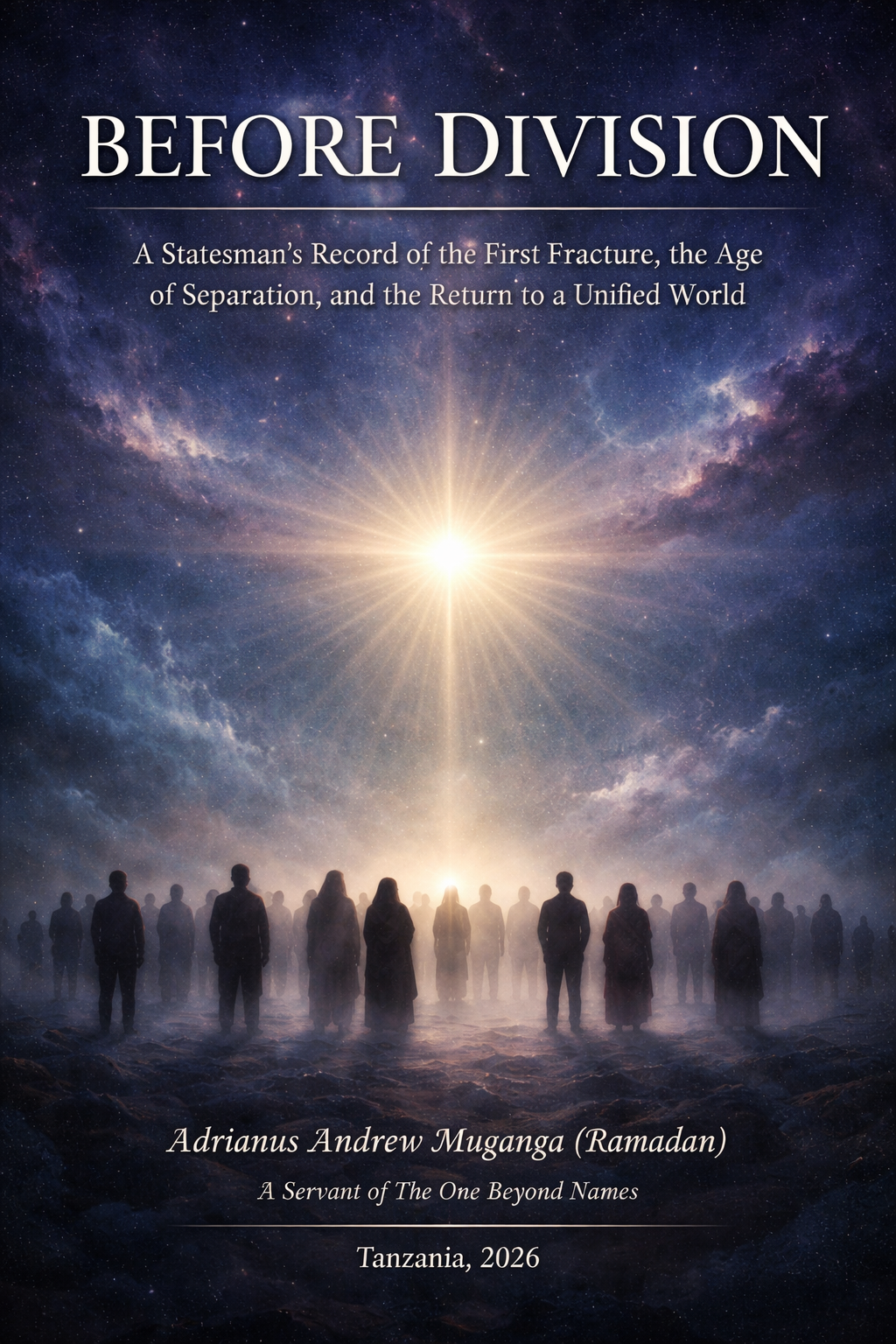
Before Division: A Statesman’s Record of the First Fracture, the Age of Separation, and the Return to a Unified World is a comprehensive philosophical work that examines the origin, development, and possible resolution of division within humanity. It approaches this subject not from within any single religious, cultural, or ideological framework, but from a position of structured observation and analysis. The central premise of the book is that division is not an inherent condition of humanity, but a constructed outcome resulting from misalignment between perception and reality.
The work begins by establishing a foundation that precedes identity. It explores the condition of the human being before labels such as religion, nationality, or ideology become the primary reference point. In this state, perception operates through direct awareness rather than interpretation shaped by belonging or comparison. The book defines this as the original condition of alignment, where responsibility, awareness, and action exist without contradiction. This foundation is essential, as it provides a point of comparison that allows division to be understood not as natural, but as something that emerged through specific changes in how perception functions.
From this starting point, the book identifies what it calls the first fracture. This is not presented as a single historical event, but as a gradual shift in awareness. The shift occurs when perception becomes self-referential, meaning that individuals begin to interpret reality through the lens of identity, ownership, and control. This change introduces comparison, hierarchy, and separation. What was once observed directly becomes filtered through constructed frameworks. The emergence of identity marks a turning point where interpretation begins to replace observation as the primary way of engaging with reality.
The book then traces how this initial shift expands into structured systems. As human societies develop, identity becomes embedded in religion, culture, and institutions. These systems provide organization and meaning, but they also reinforce separation when they are treated as absolute. The work examines how authority structures, doctrines, and traditions form around interpretations of truth, and how these interpretations are preserved and defended over time. It highlights that while these systems were originally developed to guide and organize human life, they gradually became sources of division when they were treated as exclusive or final representations of truth.
A significant portion of the book is dedicated to analyzing patterns across major world traditions. Rather than focusing on the details of any single religion, it identifies recurring structures that appear across all of them. These include leadership disputes, differences in interpretation, cultural influences, and political factors that contribute to fragmentation. By placing these patterns side by side, the book demonstrates that division follows a consistent structure regardless of the specific system in which it occurs. This comparative approach allows the reader to see beyond individual differences and recognize the underlying mechanisms that sustain separation.
The work also examines the Age of Separation, a period characterized by the expansion and normalization of division. During this phase, identity becomes central to how individuals and groups understand themselves and others. Institutions reinforce these identities, and systems of belief become closely tied to power, influence, and social organization. The book explains how division is maintained through reinforcement mechanisms such as education, tradition, and collective agreement. It also addresses how conflict arises when different identity-based systems interact, each operating from its own framework of certainty and authority.
In addressing why unity has historically failed, the book critiques common approaches such as interfaith dialogue and institutional reform. It argues that these efforts often operate within the same identity-based frameworks that produce division, and therefore cannot resolve it at its root. Dialogue may promote coexistence, but it rarely leads to transformation when underlying assumptions remain unchanged. The book suggests that without addressing the foundational issue of misaligned perception, attempts at unity will continue to be limited and temporary.
Moving beyond analysis, the book presents a path toward resolution. This path is based on the concept of alignment with reality. Alignment is defined as a state in which perception, understanding, and action correspond directly to what is real, rather than to constructed interpretations. The process of alignment involves recognizing and correcting distortions in perception, particularly those created by identity and assumption. It emphasizes personal responsibility in this process, stating that clarity cannot be imposed externally but must be developed through direct observation and examination.
The later sections of the book explore what a condition of alignment would look like at both the individual and collective levels. It proposes that difference does not need to be eliminated for unity to exist. Instead, it distinguishes between difference and division, arguing that diversity can remain without conflict when it is not tied to superiority or exclusivity. The book envisions a form of human organization where systems are based on shared reality rather than competing identities, allowing for cooperation without the need for uniformity.
In its final sections, the work presents a forward-looking perspective on the future of humanity. It suggests that increasing global connection and access to information are creating conditions in which existing structures of division are becoming more visible and more difficult to sustain. This visibility creates both tension and opportunity. The outcome depends on whether individuals and systems choose to maintain identity-based frameworks or move toward alignment with reality.
Throughout the book, the tone remains analytical and non-prescriptive. It does not ask the reader to adopt a belief or follow a particular path. Instead, it provides a framework for examining reality and encourages the reader to test its observations through reasoning and experience. The work positions itself as both a record of how division operates and a tool for identifying and correcting misalignment.
Ultimately, Before Division presents a unified argument that humanity’s fragmentation is not inevitable. By understanding the origins and mechanisms of division, it becomes possible to move toward a condition where clarity replaces confusion, responsibility replaces projection, and cooperation replaces conflict. The book invites readers to engage with its content not as passive recipients, but as active participants in the process of observation and understanding.
#Philosophy Of Truth
#Epistemology
#Human Perception
#Identity Formation
#Comparative Religion
#Social Systems
#Consciousness Studies
#Cognitive Frameworks
#Belief Systems Analysis
#Unity And Division
#Human Behavior
#Cultural Structures
#Logic And Reasoning
#Metaphysics
#Societal Evolution
#Conflict Theory
#Interdisciplinary Philosophy
#Systems Thinking
#Ethics And Responsibility
#Global Integration








_ebookfrontcover.jpeg)