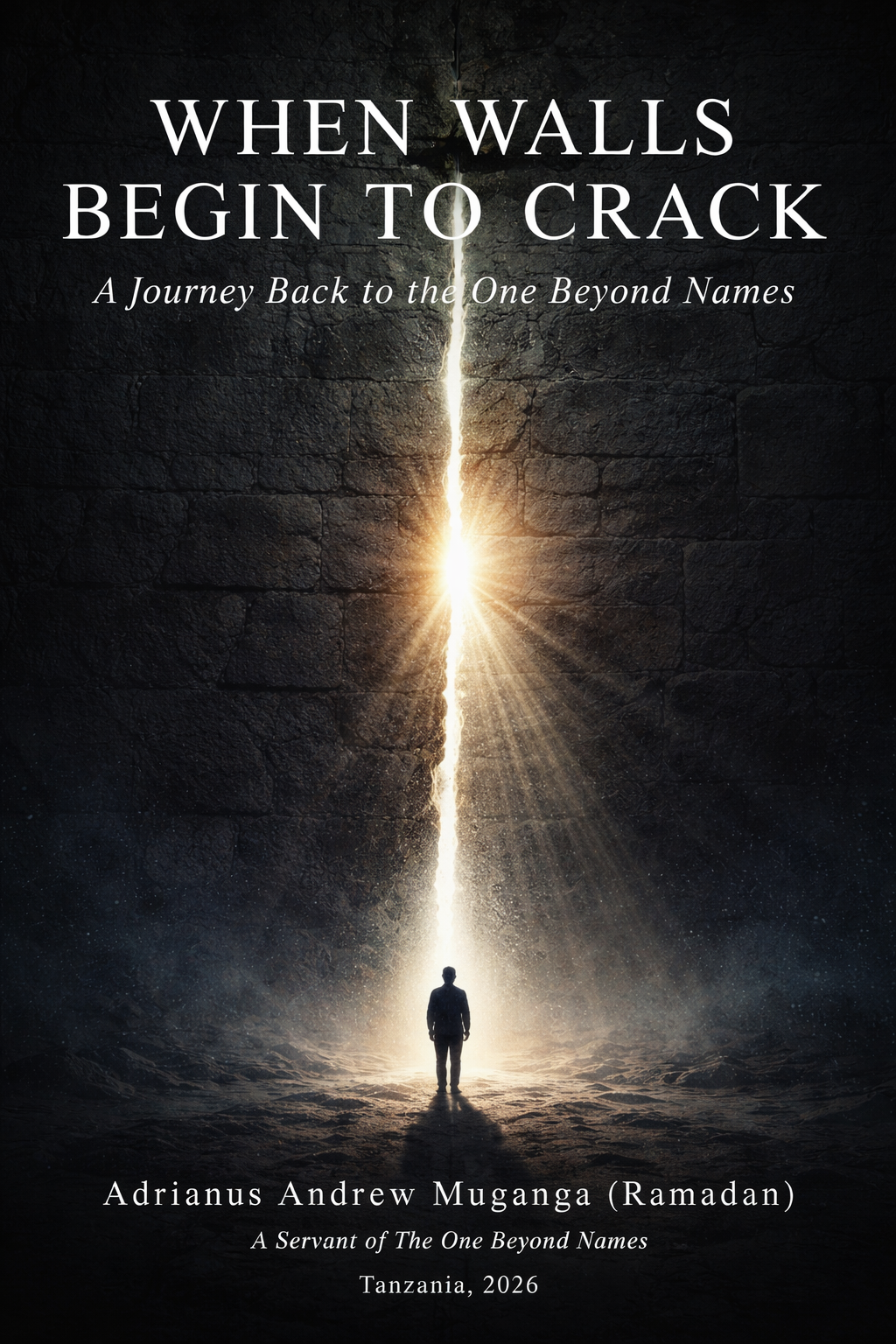
When Walls Begin to Crack: A Journey Back to the One Beyond Names is a deeply structured and reflective exploration of the human condition, focused on one central question that underlies all systems of belief, identity, and meaning: is humanity fundamentally one, or inherently divided? Rather than approaching this question through argument or ideology, the book unfolds as a process of observation, guiding the reader through the patterns that have shaped human understanding across time.
The work begins by establishing a clear position. It does not defend any religion, tradition, or system, nor does it attempt to replace one framework with another. Instead, it places truth at the center and invites it to stand without protection. This approach removes the need for agreement and shifts the focus toward recognition. The reader is not asked to believe, but to observe carefully and see whether the patterns presented correspond to reality.
At the heart of the book is a structured journey through six stages of human development. These stages are not presented as rigid historical periods, but as recurring patterns that can be observed across cultures, traditions, and time. The first stage, presence, refers to a condition in which human awareness of the sacred was direct and unmediated. In this state, understanding did not rely on systems, doctrines, or institutions. It was immediate, even if not fully articulated. This stage serves as a reference point, not as an idealized past, but as an indication of what existed before formal structures were created.
The second stage, formation, emerges as human societies begin to preserve and transmit this direct awareness. Systems are developed in the form of texts, rituals, and institutions to maintain continuity. These systems are not presented as errors, but as necessary responses to the challenge of preserving meaning over time. However, the act of preservation introduces structure, and with structure comes interpretation. As different groups interpret and organize the same underlying experiences in different ways, variation begins to appear.
The third stage, division, marks a critical shift. Systems that were originally created to preserve understanding become closely tied to identity. Belonging becomes defined through adherence to specific structures, and distinctions between groups become more pronounced. Over time, these distinctions solidify into boundaries, creating separation between people who otherwise share the same fundamental human condition. This stage reveals how identity, while providing orientation and belonging, can also contribute to division when it becomes rigid and exclusive.
The fourth stage, collapse, does not refer to the disappearance of systems, but to the exposure of their limitations. In the modern world, individuals are increasingly confronted with contradictions between what systems claim and what is experienced in reality. Access to multiple perspectives has expanded, and traditional frameworks are no longer encountered in isolation. This creates a condition in which previously stable structures are questioned, not necessarily rejected, but no longer accepted without examination. The result is a growing sense of disconnection and uncertainty, as individuals navigate between competing interpretations without a clear basis for integration.
The fifth stage, recognition, represents a turning point. At this stage, attention shifts from defending or rejecting individual systems to observing the underlying patterns that have shaped them. The focus is no longer on which system is correct, but on how systems themselves have developed and how they influence perception. This shift allows for a more precise understanding of both the value and the limitations of existing structures. Recognition does not immediately resolve division, but it changes the level at which it is approached, opening the possibility for a different kind of clarity.
The final stage, return, is not a return to the past, but a movement toward alignment. It involves integrating the clarity gained through recognition with the structures that exist in the present. Systems are not eliminated, but repositioned. They are no longer treated as absolute authorities, but as tools that can support understanding when used appropriately. This stage emphasizes both individual and collective responsibility, recognizing that transformation requires participation at multiple levels.
Throughout the book, these stages are not presented as abstract concepts alone. They are grounded in real human experiences, demonstrating how the patterns described are reflected in everyday life. These stories provide a bridge between structural analysis and lived reality, allowing the reader to see how large-scale patterns manifest at the level of individual experience.
A key distinction that runs through the entire work is the difference between agreement and recognition. Most forms of reading are guided by the impulse to agree or disagree, but this book challenges that approach. Agreement operates within existing frameworks of belief, while recognition requires direct observation. By shifting the focus to recognition, the book encourages the reader to engage with the material without immediately filtering it through prior assumptions. This allows for the possibility of encountering something new, rather than reinforcing what is already known.
The book also addresses the current global condition, characterized by increased connectivity alongside persistent division. As different systems of belief and identity now exist in close proximity, contradictions that were once isolated are now visible. Efforts toward dialogue and cooperation have increased, but often remain limited by the structures that produced division in the first place. This context makes the central question of the book increasingly urgent, as the way humanity understands itself directly influences its ability to respond to shared challenges.
Importantly, the book does not offer a final answer in the form of a conclusion that must be accepted. Instead, it provides a framework through which the reader can observe patterns and arrive at their own recognition. The emphasis remains on clarity rather than persuasion, and on understanding rather than belief.
In its overall movement, When Walls Begin to Crack is not simply a critique of existing systems, nor is it a call to abandon them. It is an invitation to see more clearly how those systems came to be, how they function, and how they shape the experience of being human. By bringing these patterns into view, the book opens the possibility of moving beyond division without denying diversity, and of engaging with truth in a way that does not depend on defense or identity.
The journey it presents is both analytical and reflective, demanding attention and willingness from the reader. It does not promise comfort or easy answers, but it offers something more precise: the opportunity to recognize what has been shaping human experience, and to consider what becomes possible when that shaping is understood.
#Unity Of Humanity
#Human Identity
#Beyond Religion
#Philosophy Of Truth
#Spiritual Awakening
#Comparative Religion
#Human Consciousness
#Global Unity
#Inner Awareness
#Religion And Society
#Breaking Division
#Search For Meaning
#Human Nature
#Truth Beyond Belief
#Alignment And Awareness






_ebookfrontcover.jpeg)