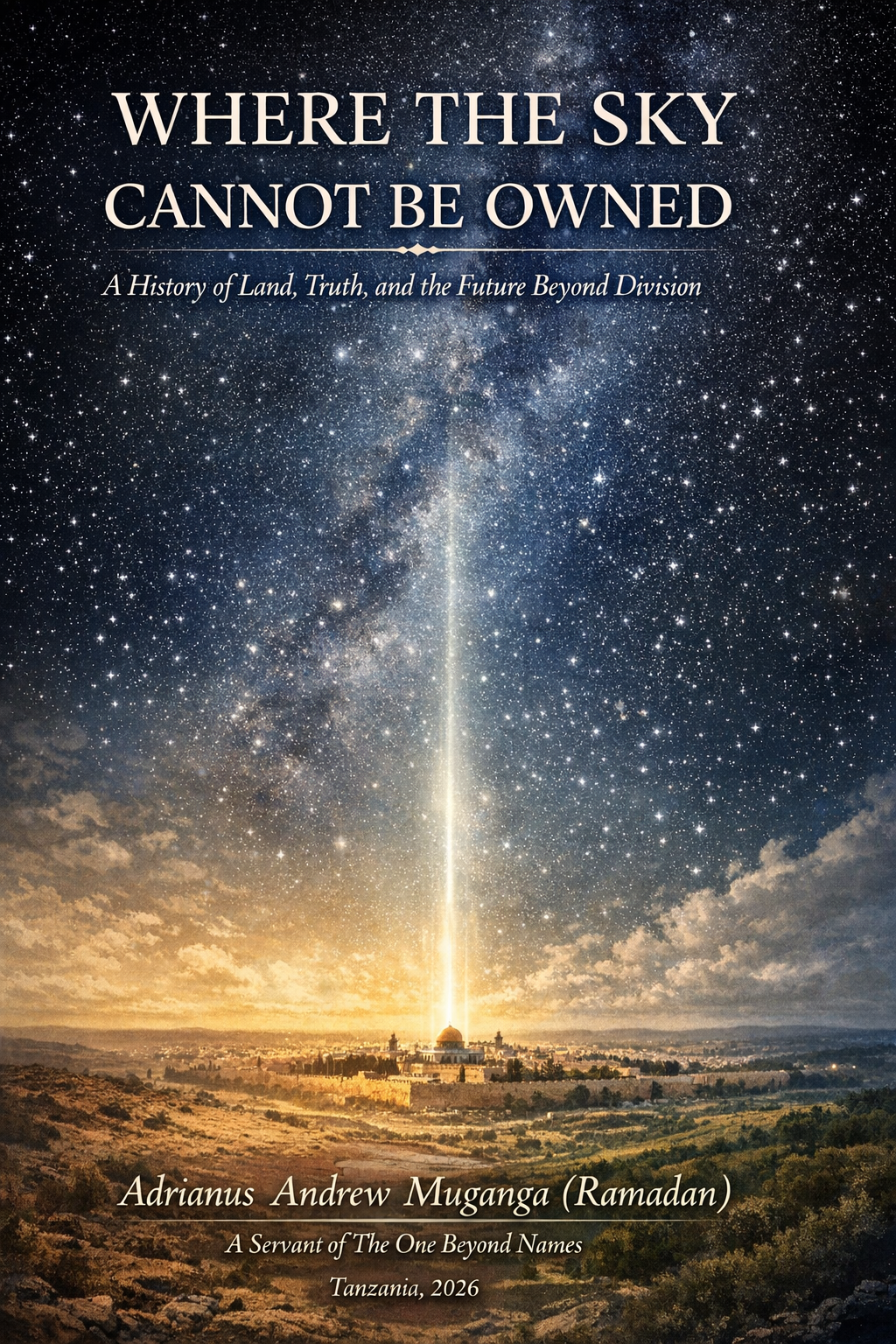
Where the Sky Cannot Be Owned is a structured and reflective exploration of how humanity came to define land, identity, and belonging through systems that continue to shape the modern world. The book begins by stepping outside familiar assumptions, inviting the reader to consider a time before borders, before ownership, and before identity was tied to territory. In this early human condition, land was not divided or claimed. It was lived upon, shared, and experienced as part of existence rather than as property.
From this foundation, the book traces the gradual transformation of human organization. As communities grew and memory deepened, the need to define, preserve, and protect emerged. What began as simple recognition of place evolved into attachment, and eventually into claims. Over time, these claims hardened into boundaries, and boundaries into systems. The shift from shared existence to structured ownership marked a turning point in human history, introducing both order and division.
The narrative then examines how identity formed alongside these changes. Initially fluid and shaped by experience, identity became increasingly fixed as societies developed language, culture, and belief systems. These elements provided meaning and continuity, but they also created distinctions between groups. The book carefully explores how identity, once a reflection of lived reality, became something that could be defined, defended, and at times imposed.
A significant portion of the work focuses on the relationship between land and identity, particularly in regions where this connection has become deeply contested. Without reducing the complexity of these realities, the book uses such cases to illustrate broader patterns. It highlights how historical events are often layered with interpretation, and how narratives can shape perception as much as facts themselves. By distinguishing between what happened and how it is understood, the book encourages a more careful and balanced engagement with history.
Religion is examined as one of the most powerful forces in shaping both identity and claims to land. The book does not approach religion as a source of conflict in itself, but as a system of meaning that has been interpreted and applied in different ways over time. It considers how sacred narratives and beliefs can deepen connection to land while also contributing to division when combined with political and social ambitions.
As the narrative progresses, attention shifts to the development of formal systems such as states, laws, and political structures. These systems were created to manage complexity, maintain order, and provide stability. However, the book argues that they also reinforced divisions by formalizing boundaries and institutionalizing identity. What may have begun as practical solutions gradually became rigid frameworks that defined who belongs and who does not.
The modern world is presented as the result of these layered developments. Nations, borders, and identities are shown not as natural or inevitable, but as outcomes of historical processes. The book emphasizes that many of the conflicts seen today are rooted in these inherited structures. By understanding their origins, it becomes possible to see beyond them.
At the same time, the book acknowledges the changing nature of the global condition. Advances in communication, migration, and shared challenges such as environmental change have created a level of interconnection that was previously unimaginable. These changes raise important questions about whether traditional systems of identity and territory remain adequate. The book does not suggest simple solutions, but it opens space for reconsideration.
Throughout, the work maintains a careful balance. It does not argue for the erasure of identity or the abandonment of all systems. Instead, it calls for a deeper awareness of how these systems function and how they influence perception. By understanding their constructed nature, individuals and societies may become better equipped to navigate them with greater flexibility and awareness.
One of the central ideas of the book is the distinction between reality and interpretation. Events occur, but the meanings attached to them are shaped by perspective, culture, and context. This distinction is essential for understanding conflict, as it reveals how different groups can experience and interpret the same history in different ways. Recognizing this does not eliminate disagreement, but it can create space for dialogue.
The book also emphasizes the importance of returning to fundamental human principles. Before systems and structures, there was shared existence. While it is not possible to return to that state, the awareness of it can inform how modern systems are understood and potentially reimagined. The idea is not to reject progress, but to align it more closely with a broader sense of human connection.
In its later sections, the work explores the possibility of moving beyond rigid divisions without losing meaning or stability. It considers how identity might evolve in a way that allows for both individuality and shared humanity. It also reflects on how land might be understood not only as territory to be owned, but as space to be respected and sustained.
Ultimately, Where the Sky Cannot Be Owned is not a prescriptive text. It does not offer fixed answers or definitive conclusions. Instead, it presents a framework for thinking. It encourages readers to question assumptions, to examine the origins of what is often taken for granted, and to consider alternative ways of understanding the world.
The title itself reflects the central idea of the book. While land can be divided and claimed, the sky remains beyond ownership. It serves as a metaphor for what is shared, what cannot be contained, and what connects all human beings regardless of borders or identity.
By the end of the book, the reader is left not with a single conclusion, but with a clearer view. The work invites reflection rather than agreement, understanding rather than reaction. It is an exploration of how humanity came to be organized as it is, and a quiet consideration of what might still be possible beyond division.
#Land Ownership
#Borders
#Identity
#Geopolitics
#Middle East History
#Israel Palestine
#Human History
#Political Systems
#Social Structures
#Philosophy Of Identity
#Territorial Conflict
#Global Systems
#Nationalism
#Human Geography
#Conflict Analysis
#Historical Narrative
#Cultural Identity
#Power And Control
#Origin Of Borders
#Shared Land
#Colonial Legacy
#Modern Conflict
#Political Philosophy
#Global Change
#Society And Systems
#Identity Formation
#Land And Power
#Historical Analysis
#World History
#Future Of Humanity
#Division And Unity
#Territorial Identity
#State Formation
#Social Evolution
#Human Civilization
#Conflict Resolution
#Global Perspective
#Systems Thinking
#History And Philosophy
#Land Disputes
#Human Connection
#Shared Humanity
#Beyond Borders
#Political History
#Cultural Systems
#Identity And Land
#Global Society
#Human Order
#Origin Of Nations
#World Systems



_ebookfrontcover.jpeg)