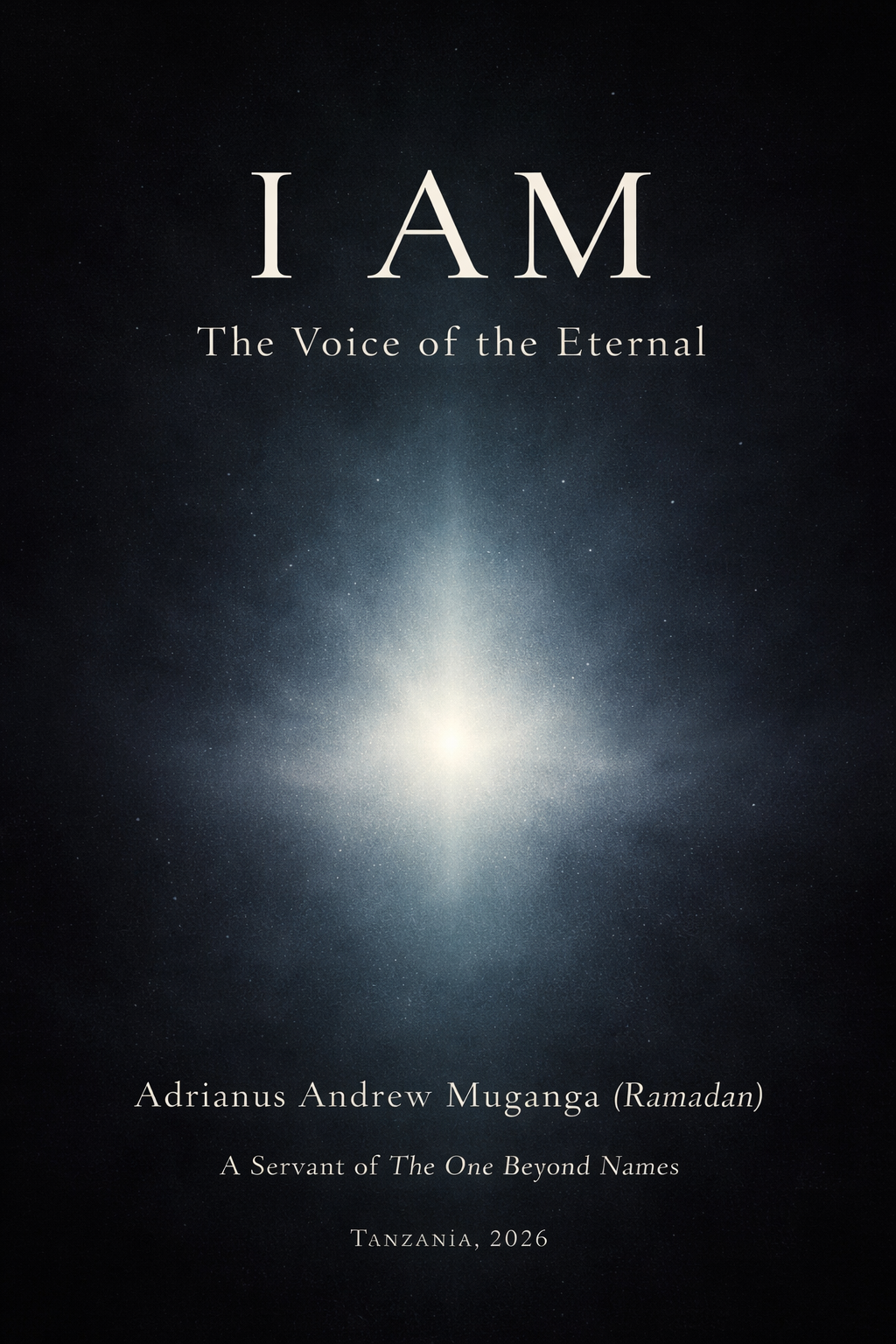
I AM: The Voice of the Eternal is a contemplative work that examines the nature of awareness, identity, and the human tendency to search for meaning and completion. The book does not present a belief system, religious doctrine, or self-improvement method. Instead, it encourages direct observation of experience and invites the reader to question deeply rooted assumptions about who they are and how they perceive reality.
Structured into seven parts and fifty-one chapters, the book gradually explores fundamental aspects of human consciousness. It begins by pointing to what exists prior to thought, language, and identity, emphasizing that many of the divisions people experience are formed through mental processes rather than inherent reality. Early chapters focus on the role of thought, naming, and conditioning in shaping perception, highlighting how these processes create a sense of separation and ongoing psychological movement.
As the book progresses, it addresses the idea of seeking. It examines why individuals feel incomplete and how the belief in something missing leads to constant searching through knowledge, experience, and external validation. The text suggests that this search is sustained by the assumption that fulfillment exists somewhere else, rather than in present awareness. By bringing attention to this pattern, the book proposes that what is being sought may not be absent, but simply overlooked.
Later sections explore the structure of identity and the concept of the self. The book questions the idea of a fixed, separate individual and examines how identity is formed through memory, social conditioning, and repeated thought patterns. It also considers how attachment to these structures contributes to conflict, comparison, and dissatisfaction. Rather than offering a replacement identity or belief, the text points toward observing these processes as they occur.
The book also addresses the broader human experience, including the creation of division in society, the reliance on systems of belief, and the consequences of living from a fragmented perception of reality. It does not criticize these developments directly, but presents them as outcomes of misunderstanding the nature of awareness and separation.
In its later parts, the focus shifts toward what the book describes as “return.” This is not presented as a journey or a process of becoming, but as the recognition of what has always been present. The text emphasizes that clarity does not come from effort, accumulation, or transformation, but from seeing without distortion. It suggests that when the movement of seeking and mental noise quiets, there is a natural recognition of a state that is not dependent on thought or identity.
Throughout the book, the language remains direct and reflective. It avoids technical terminology and instead uses simple expressions to point toward experiences that can be observed immediately. The intention is not to persuade or instruct, but to create space for insight through careful attention.
I AM: The Voice of the Eternal is suitable for readers interested in philosophy, spirituality, and self-inquiry, particularly those who prefer exploration over doctrine. It does not require prior knowledge of spiritual traditions or philosophical systems. Instead, it offers an open-ended inquiry into the nature of being, encouraging readers to look beyond familiar patterns of thinking and to examine what is present before interpretation.
Rather than providing answers, the book leaves the reader with a deeper awareness of the questions themselves, and the possibility that clarity arises not from finding new conclusions, but from seeing what has always been here.
#Awareness
#Nonduality
#Consciousness
#Self Inquiry
#Inner Truth
#Spiritual Awakening
#Presence
#Mindfulness
#Identity
#Perception
#Reality
#Thought
#Stillness
#Enlightenment
#Inner Peace
#Philosophy
#Existence
#Being
#Truth
#Self Discovery







_ebookfrontcover.jpeg)