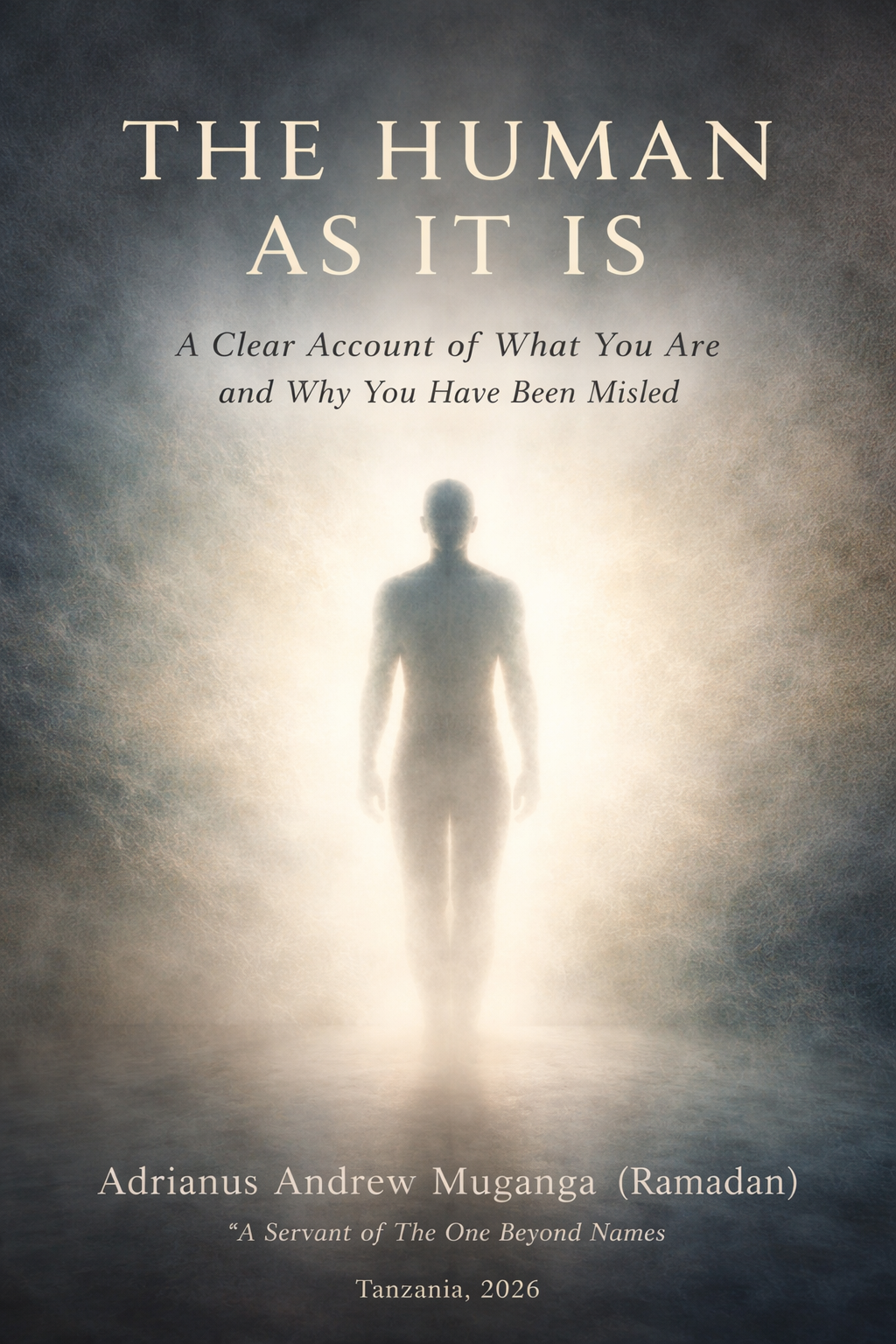
THE HUMAN AS IT IS: A Clear Account of What You Are and Why You Have Been Misled is a structured examination of the human being approached through direct observation rather than belief, theory, or philosophical argument. It does not attempt to define the human through abstract systems or inherited ideas. Instead, it focuses on what can be seen in immediate experience, in thought, in behavior, and in the subtle processes that shape perception and identity.
At the center of the book is a simple but fundamental concern: the question of what a human being actually is when all assumptions, labels, and learned descriptions are set aside. The text suggests that much of what individuals take themselves to be is constructed through conditioning, language, memory, and repeated patterns of thought. These constructions form a sense of self that appears stable and real, yet upon closer observation reveals itself to be fragmented, reactive, and dependent on external and internal influences.
The book carefully examines the movement of thought as a central factor in the formation of identity. Thought is shown not merely as a tool for practical functioning, but as a continuous process that interprets, labels, and organizes experience. In doing so, it creates a narrative of self that is often mistaken for something inherent or fixed. This narrative is sustained through memory and reinforced through repetition, giving rise to a sense of continuity that may not actually exist in the way it is perceived.
A significant portion of the work is dedicated to exploring psychological conditioning. From early life, individuals absorb beliefs, values, fears, and expectations from their environment. These elements become embedded in the way one perceives and responds to the world. The book highlights how this conditioning operates largely without awareness, shaping reactions, preferences, and judgments. What is often considered personal choice or individual identity is, in many cases, an expression of this conditioning.
Fear and desire are examined as key movements within this conditioned structure. Fear is presented not only as a response to immediate danger, but as a psychological process rooted in thought, often connected to memory and projection. Similarly, desire is explored as a movement driven by images and expectations created by thought. Both fear and desire contribute to a constant state of seeking and avoiding, which sustains inner conflict and restlessness.
The text also addresses the role of control and effort in human experience. It questions the common assumption that clarity or change can be achieved through willpower, discipline, or the adoption of methods. Instead, it suggests that such efforts may reinforce the very structures they attempt to alter, as they originate from the same conditioned processes. The pursuit of becoming something different is examined as part of the ongoing activity of the self, rather than a movement beyond it.
Another central theme is the nature of perception. The book points out that perception is rarely direct. It is typically filtered through layers of interpretation, belief, and prior knowledge. This filtering distorts what is seen, replacing direct observation with conclusions and assumptions. The result is a separation between what is actually occurring and what is perceived to be occurring. The text invites attention to this gap, not as a problem to solve, but as something to be clearly seen.
Importantly, THE HUMAN AS IT IS does not offer solutions, practices, or conclusions. It deliberately avoids providing systems to follow or answers to adopt. This is not due to omission, but because the book questions whether such approaches can lead to genuine understanding. Any method, it suggests, becomes another layer of conditioning, another structure within which the mind operates.
Instead, the book remains grounded in description. It presents observations in a clear and consistent manner, allowing the reader to see these processes as they unfold. The emphasis is on direct seeing, without distortion, without the interference of interpretation or expectation. This kind of observation is not presented as a technique, but as a natural capacity that is often overlooked.
The tone of the work is neutral and precise. It does not attempt to persuade, inspire, or comfort. It also does not position itself as an authority. The absence of authority is central to its approach. The reader is not asked to accept what is written, but to look and see whether it corresponds to their own experience.
As the book progresses, it moves from more apparent aspects of behavior and thought toward deeper examination of the mechanisms that sustain identity and perception. This movement is not linear in a traditional sense, but cumulative, with each section building clarity around the central themes. The structure supports a gradual uncovering of patterns that may otherwise remain unnoticed.
In its entirety, THE HUMAN AS IT IS functions as an invitation rather than a directive. It does not seek agreement or validation. It offers a space in which the reader can encounter the processes that shape their experience without interference. What is revealed in that encounter is not predetermined by the text.
The core of the book lies in this: that understanding may not come from acquiring new knowledge, but from seeing clearly what is already taking place. In that sense, the work does not add to what the reader knows, but challenges the very framework through which knowing is understood.
#Human Nature
#Consciousness
#Identity
#Perception
#Self Awareness
#Psychological Conditioning
#Human Behavior
#Introspection
#Philosophy
#Philosophy Of Mind
#Reality
#Illusion Of Self
#Thought Process
#Awareness
#Cognition
#Observation
#Belief Systems
#Personal Inquiry
#Mind And Self
#Non Fiction











_ebookfrontcover.jpeg)