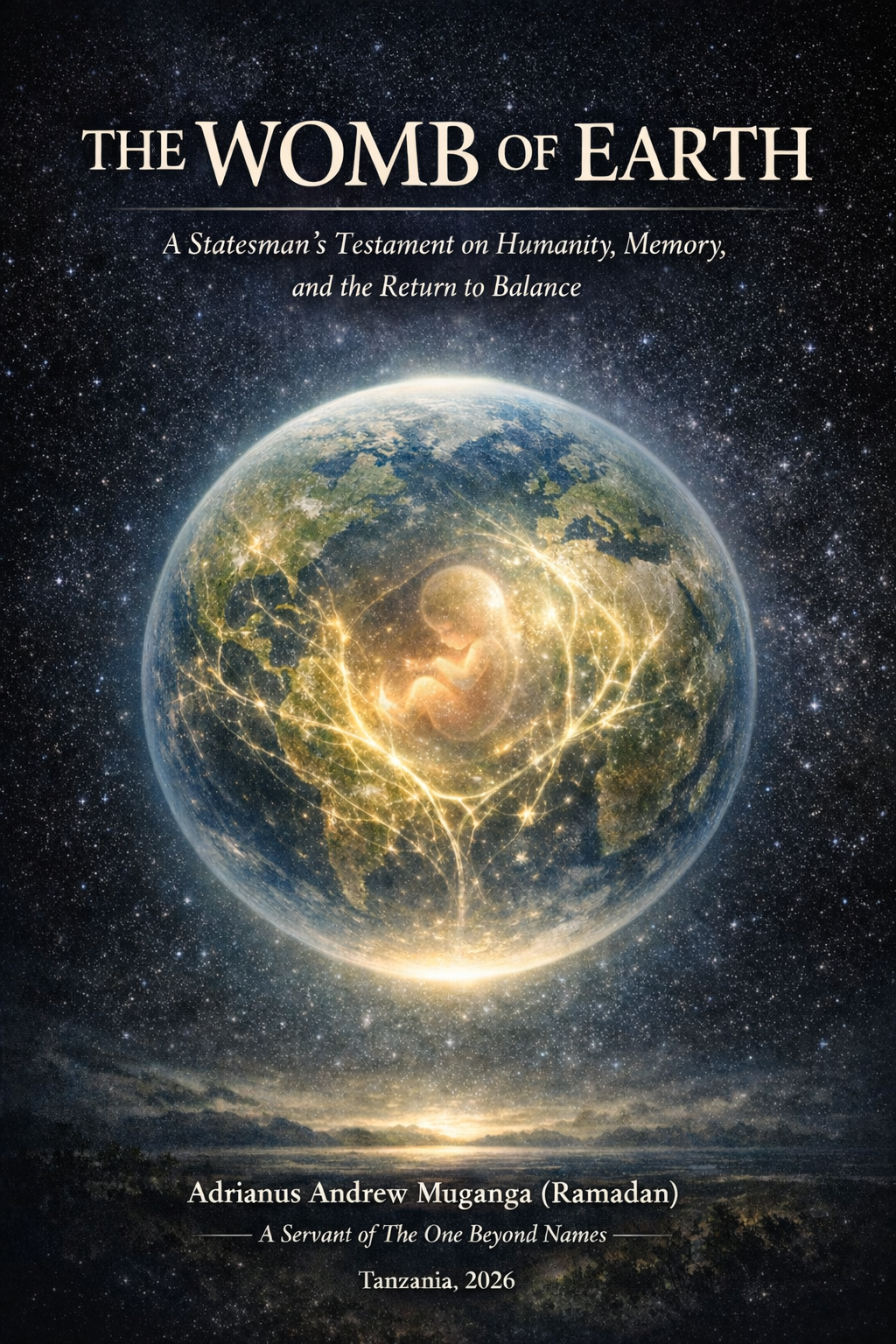
The Womb of Earth: A Statesman’s Testament on Humanity, Memory, and the Return to Balance is a philosophical and structural examination of humanity as a single, interconnected system that has fallen into a state of fragmentation. At its core, the work confronts a fundamental question: if humanity is inherently one, why does it function as though it is divided?
Rather than approaching this question through ideology, doctrine, or abstract speculation, the book presents a deliberate and measured inquiry into the patterns that shape human existence. It argues that division is not an inherent condition, but a constructed and sustained reality, reinforced over time through social, political, cultural, and economic systems. These systems, while appearing distinct, are deeply interconnected and collectively contribute to the normalization of imbalance.
Central to the book’s framework is the concept of collective memory. The author proposes that humanity once functioned with a clearer sense of continuity and interdependence, but over time, this memory has been fragmented, obscured, and in many cases, replaced by narratives that prioritize separation. This erosion of memory is not presented as a singular event, but as an ongoing process, embedded within institutions, identities, and inherited assumptions.
As collective memory weakens, humanity becomes increasingly dependent on constructed frameworks to define meaning, belonging, and purpose. These frameworks, while often necessary for organization and survival, can also reinforce division by emphasizing difference over unity. The book examines how identity, power structures, and systems of governance contribute to this dynamic, often without conscious intent. In doing so, it highlights the subtle ways in which fragmentation is maintained, not only through conflict, but through normalization.
The work does not seek to assign blame or isolate responsibility. Instead, it frames humanity as both the creator and participant in these systems. This dual role complicates the possibility of change, as individuals are simultaneously shaped by and contributors to the very structures that sustain imbalance. The book emphasizes that transformation cannot occur solely at the level of policy or ideology, but must involve a deeper recognition of the patterns that underlie human behavior.
Throughout the text, the author maintains a careful balance between analysis and reflection. The tone is neither accusatory nor prescriptive, but observational. This approach allows the reader to engage with the material without being directed toward a fixed conclusion. Rather than offering solutions, the book creates space for recognition, suggesting that awareness itself is a necessary condition for any meaningful shift.
A key aspect of the book’s argument is that the return to balance does not require the invention of new systems, but the re-alignment of existing ones. It proposes that beneath the layers of fragmentation, there remains an underlying coherence that has not been lost, only obscured. This perspective challenges the assumption that progress must always involve addition or expansion, instead suggesting that restoration may involve removal, simplification, and reconnection.
The idea of return is central to the work, but it is carefully defined. It does not refer to a regression to a specific historical moment, nor does it idealize the past. Instead, return is framed as a movement toward alignment with principles that are not bound by time. These principles, while not explicitly codified, are implied through the book’s emphasis on balance, interdependence, and responsibility.
Responsibility, in particular, is treated as a shared condition rather than an individual burden. The book challenges the tendency to externalize problems, arguing that the structures humanity inhabits are reflections of collective behavior. As such, the process of change cannot be separated from the process of self-examination. This does not imply uniformity or the erasure of difference, but rather a recognition that diversity exists within a larger unity.
The text also engages with the role of language and perception in shaping reality. It suggests that the way humanity describes itself influences how it behaves. When language reinforces division, behavior often follows. Conversely, when language reflects interconnection, it can create the conditions for different forms of interaction. This insight underscores the importance of clarity and intention in both thought and communication.
Positioned at the intersection of philosophy, social theory, and civilizational critique, The Womb of Earth does not fit neatly within a single discipline. Its scope is intentionally broad, reflecting the complexity of the subject it addresses. At the same time, the structure of the book provides a clear progression, guiding the reader from the recognition of fragmentation toward the possibility of alignment.
The work speaks to a wide audience, including individuals seeking deeper understanding, as well as those engaged in leadership, governance, and institutional design. Its relevance lies not in offering immediate answers, but in reframing the questions that guide decision-making at all levels. By shifting the focus from isolated problems to underlying patterns, the book encourages a more integrated approach to understanding and addressing global challenges.
Ultimately, The Womb of Earth is not presented as a conclusion, but as an opening. It does not claim to resolve the tensions it identifies, but to make them visible. In doing so, it invites the reader to participate in a process of recognition that extends beyond the text itself. The possibility of return, as described in the book, is not dependent on the work alone, but on the willingness of humanity to observe itself with clarity and to act with a renewed sense of alignment.
#Philosophy
#Social Systems
#Collective Memory
#Human Behavior
#Ethics
#Systems Thinking
#Global Society
#Civilizational Studies
#Human Unity
#Structural Analysis
#Cultural Patterns
#Political Thought
#Moral Philosophy
#Societal Dynamics
#Human Consciousness
#Interdisciplinary Studies
#Governance
#Sustainability
#Social Theory
#Identity







_ebookfrontcover.jpeg)